
Nov 18, 2026
How to Choose the Right Modern Decorative Trim Profile for Your Project
To choose the right modern decorative trim profile, start with the wall system it must finish. Confirm the slot or edge dimensions of your panels, then select an aluminum alloy profile with a suitable thickness, length, and anodized finish of at least 10μm. Match the visible shape to your interior style, test samples on real panels, and check the supplier's inspection records and delivery time. A good profile hides raw edges, creates clean transitions, installs quickly, and keeps its color over time. Below, I explain each decision step by step so you can compare options with confidence.
Start With Your Project and Panel System
Define Where the Trim Sits and What It Must Do
I always start by asking, "What does the trim need to do?" Putting a profile between a wall panel and a marble panel makes a straight line. This hides a cut. A curve can frame the surface and add a shadow line along a feature wall. It's important to write down where it is, how many square meters it is, and what end you want. Include the things you'll need for packing and paperwork. This quick project sheet cuts down on the time spent talking to suppliers back and forth. As a result, the provider doesn't have to guess what kind of modern decorative trim profile will look best with the picture. Having a drawing is even better because it makes the joint stand out more and gives better advice.
Match the Slot Tolerance to Your Wall Panels
People are more upset about fit than color. It takes time for installers to try to force a trim into a panel slot that it doesn't fit. They need to fill in the blanks too. Heat and moisture can also make panels move, so the fit should be a little open. To meet our quality standards, the space between panels has to be 0.75 to 1 mm of the thickness of each one. This lets the screens get bigger and smaller as winter and summer come and go. You can use calipers to find out how deep and how thick your panel is. Then send a drawing or sample for a test fit. From what the ASM Handbook says, aluminum grows by 23 micrometers per meter for every degree Celsius. A 3-meter piece grows about 1.4 mm over a 20°C swing. It's important for the fit to be snug but not tight, as that number shows.
Consider Environment and Traffic
The setting changes the small things. The places with a lot of water are basements, bathrooms, and kitchens. A metal finish that doesn't rust is helpful in these places. The sides of things that are out in the open need to be made of a hard material that can be wiped down. This is because these places get a lot of cleaning and bumps from carts and bags. In school and hospital halls, damage is even worse, so it's even more important to protect the edges there. Fire safety rules apply to the whole assembly, even though aluminum doesn't catch fire. This includes the panels and glues. IBC Chapter 8 tells us how to finish the inside of a building in the United States. But the city government has the last word. You can ask your provider for any papers that your inspector might need. Our CE and RoHS records are yours if you ask for them. The plant we work with is also certified to ISO 9001:2015.
Compare Materials, Thickness, and Finish
Aluminum Compared With PVC and Polyurethane
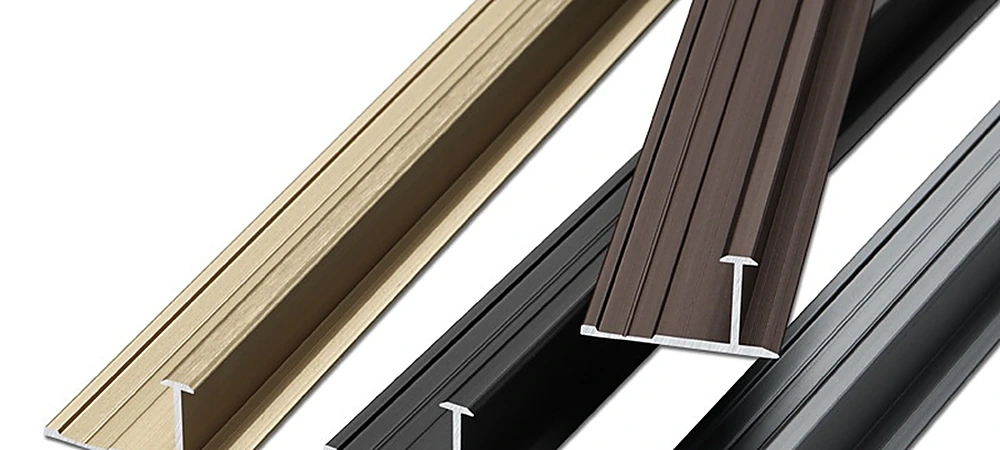
Everything is meant to be there. The lightness and lack of damage from water make PVC easy to work with. Polyurethane is easy to paint and can be used to make complex shapes. You can finish aluminum in gold, black, or silver, and it's easier to work with and holds its shape better. It's about 2.7 g/cm³ dense, which means it weighs about a third as much as steel. This makes it easy to move and set up a 3 m length. When it gets warm, plastic trim can bend or soften. On the other hand, metal profiles stay straight over long runs. That's why the aluminum we use in our trims is so good. If you're thinking about a material, don't just go by its name; also ask for information on its finish and tolerances.
Pick the Right Thickness and Length
There are three different widths of our modern decorative trim profile: 0.5 mm, 0.8 mm, and 1.0 mm. You can also ask for different widths. Less thick walls with light-colored edges look good and keep the weight down. The edges of walls that are thicker feel stronger and don't bend as easily when you touch them. See how the edge will fit against the surface. This comes in 3000 mm lengths, but you can get it in any length you need. Less waste and more visible seams are created when pieces are longer. As a rule, ASTM B221 is often used for architectural extrusions. In the Aluminum Design Manual from the Aluminum Association, you can find metal strength data that your engineer wants. Compare the two widths of cuts by hand. It's simple to understand.
Anodized Finish and Color Consistency
The film on the surface tells us how long the trim will look brand new. A layer of oxide is added to the metal during anodizing. This layer stops the aluminum from peeling like paint does. Our profiles have an anodized film that is at least 10µm thick, which is the minimum thickness for a Class II ornamental finish according to AAMA 611. Thick films work best for harsher exposure. Color is just as important on a long wall run. Metallic coatings come in gold, black, silver, and any color you want. This is done at our factory to make sure that metallic coatings are always the same from one batch to the next. A good sample should be kept so that it can be used to judge each new supply. Follow the steps in ASTM to get a test report from us on the aging of anodized film.
Match Style, Size, and Application
Pick a Style That Fits the Interior
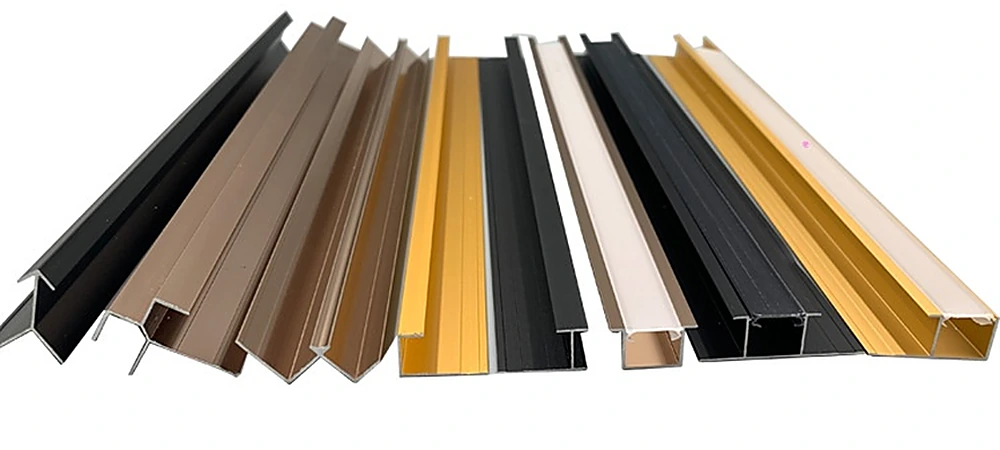
Modern decorative trim profiles look good because they are the right size, not because they are pretty. On a plain wall with big panels, a thin black line looks good. Gold makes halls and feature walls in high-end hotels feel cozier. Marble, glass, and brushed metal that are lighter look good with silver. Today, accents like these are often put together with panels that have wood grain, marble grain, or fabric texture. To make the room look put together, match the trim to either the panel or something metal, like a light fixture or door handle. If the trim is a big different color from the wall, it stands out. If it is a close match, it blends in. In his book Building Construction Illustrated, Francis D.K. Ching writes about how joints and reveals shape finished surfaces. You should test some gold and silver to see how they look under warm and cool bulbs.
Choose Width, Depth, and Configuration
How loud it talks is based on the shade line's depth and the trim's width. When there are a lot of different layouts and small rooms, narrow profiles work well. On tall walls and in hotel hallways, ones that are wider or deeper work well. I-trim is used to connect panels, and edge trim is used to finish off areas that aren't being covered. Look at a picture with measurements and mark on your wall plan where the joints will be before you agree on a size. The length of 3000 mm helps you plan your cuts so that the scraps aren't too big. It's also important how high the ceiling is. If the frame looks fragile in the living room, it might not stand out at all in the hallway with the high ceiling. You should always look at a sample and a real panel side by side before you place an order.
Confirm Compatibility With Panels and Installation
You can use our trims with wall panels, slat panels, and marble panels. This means that you can use the same family of modern decorative trim profiles for more than one type of surface. Long pieces of aluminum are easier to move because they are light. This keeps workers from getting too tired on big jobs. Check three things before you put it in. First, make sure the base is clean and flat. Second, the wall and the metal should both stick together with the same glue or method. Third, make a paper plan of the corners and joints. First, put one piece to the test to see how well it fits and how strong the binding is. The skirting boards, grilles, and trims for full wall systems can all be bought from the same company. Things will match up in terms of color and finish this way. Take one last look to make sure there are no dents, scratches, straight lines, or parts that aren't level.
Evaluate the Supplier and Plan the Purchase
Check Quality Control and Documents
Anyone who sells things can tell you how they check the sizes, surfaces, and packing. Our quality control method is made up of two parts: an inspection at the plant and a random check before the goods are sent out. Inspectors look at the condition of the surface, the size of the work in progress, and the raw materials that are coming in. Besides that, they test the installation simulation on 5% of each batch at random. Before they start packing, the team checks that the ocean-friendly wood boxes, edge guards, and stretch wrap are all in good shape. The partner factory has a work safety standardization certificate and an ISO 9001:2015 certificate. It has patents for both design and utility models for aluminum trim structures as well. Make sure you get records instead of promises. If buyers see the steps for inspection written down, they can figure out how risky a big order is before they place it.
Compare Standard and Custom Profiles
They're good for frequent reorders because they ship faster and have less risk in the development process. It makes sense to make your own profiles when you need a panel slot, a unique color, or a private name that isn't in the store. Our partner plant, Zhengzhou Keyi Aluminum, has over 300 mold sets. As long as they cover a lot of ground, there may already be a good match for things like skirting boards, U-shaped trims, panel edge trims, and center joint strips. You can pick from more than 100 different color and texture types. You can also get support and sizes that are made just for you from the OEM. Send a drawing along with your request for a custom profile. Also spell out the number, finish, and packing you need. Suppliers plan their production based on forecasts, so be honest about how much you need.
Plan Lead Time, Samples, and Total Cost
When you compare projects, don't just look at how much they cost per meter. Also, look at how much they cost altogether. Add up the costs of shipping, packing, duties, waste from a bad fit, and delays on site. It usually takes 7–10 days to ship, and 10–15 days to arrive. This is helpful while a panel order waits for its trim. If you have a question, we'll answer it within 24 hours. You can also get samples for free or pay for them. Get some samples first to see how they look on your panels. After that, make a small test order before you place a bigger order. Write down the Incoterms, the sizes of the boxes and pallets, and how you want to be paid. A lot of things can come up during busy times, so share your plans early.
Conclusion
Things to think about first are the project, the modern decorative trim profiles it joins, the slot tolerance, and the space it needs to work in. It is light, has straight lines, and a tough anodised finish. A film that is at least 10μm thick is needed for an AAMA 611 Class II coating. People can find the right product for their needs and cut down on joints because it comes in widths of 0.5, 0.8, and 1.0 mm and lengths of 3000 mm. Style, width, and depth should all fit the room and be seen on samples in real life. It's just as important to check the product itself as it is to check the supplier's forms, records, mold capacity, wait time, and total cost. When you start with a sample, these things fit together better. This also makes it less likely that there will be issues with fit, color, or shipping.
FAQ
1. What is a modern decorative trim profile?
Thick, shaped pieces of metal that connect or finish off wall areas. With it, cuts and rough edges are hidden, and the changes between wall panels, slat panels, and marble panels are smooth.
2. Is aluminum better than PVC or polyurethane?
You can anodize aluminum in gold, black, or silver. It stays in shape, which makes it good for long runs and busy business areas. You can use PVC and polyurethane for both easy and hard jobs. Check that the tools are right for the job.
3. Can ZX change the length, color, and depth?
Yes. We can make custom lengths, widths, and colors because we have more than 300 sets of molds. We can also work with OEMs. When you send us a drawing, the technical review goes faster, and it also helps us make a close standard profile right away.
4. What information do you need for a quotation?
Send models, information about the use, how many, what finish, how they need to be packed, and where the goods need to be shipped. We answer within 24 hours, and before you buy a lot, you can get free or cheap samples to try.
Request a Modern Decorative Trim Profile Quote From ZX
Are you ready to make the panels match the trim? You can email ZX at info@kangdishi.com with your drawings, quantities, finish, and where you want the goods to go. In 24 hours, our team will get back to you. We are a modern company that makes modern decorative trim profiles and work with a 132 mu plant partner. We can help with OEM projects and provide models and custom molds.
References
1. AAMA 611-14: Voluntary Specification for Anodized Architectural Aluminum, American Architectural Manufacturers Association, 2014
2. ASTM B221-21: Standard Specification for Aluminum and Aluminum-Alloy Extruded Bars, Rods, Wire, Profiles, and Tubes, ASTM International, 2021
3. Aluminum Design Manual, The Aluminum Association, 2020
4. ASM Handbook, Volume 2: Properties and Selection: Nonferrous Alloys and Special-Purpose Materials, ASM International, 1990
5. International Building Code, International Code Council, 2021
6. Building Construction Illustrated, Francis D.K. Ching, Wiley, 2014
Online Message