
Sep 8, 2026
What is the purpose of the Snap-fit Aluminum Skirting?
When I visited a newly renovated high-end apartment complex in Manila last year, I noticed something different about the wall-to-floor transition. The gleaming aluminum skirting had a seamless finish, no visible glue residue, and the installation crew had completed an entire floor in just three hours. That was my introduction to snap-fit aluminum skirting—a solution that addresses the core pain points that large-scale developers and construction teams face: installation speed, labor costs, and long-term durability.
Snap-fit aluminum skirting serves a dual purpose in modern construction: it provides structural protection to wall bases while delivering a clean aesthetic transition between walls and floors. Unlike traditional skirting that requires adhesives or nails, this system uses a mechanical interlocking mechanism that enables tool-free, glue-free installation—cutting on-site labor time by approximately 50% while eliminating adhesive-related mess and wall damage.
The purpose extends beyond simple decoration. For procurement managers in real estate development and commercial construction, this product solves three critical challenges: accelerating project timelines, reducing construction waste, and ensuring consistent quality across multi-batch orders. At Zhengzhou Zhongxiu Building Materials, we've supported projects ranging from Southeast Asian residential towers to Middle Eastern luxury apartments, and the feedback consistently highlights these functional advantages.
Understanding Snap-Fit Aluminum Skirting: Definition and Core Purposes
Snap-fit aluminum skirting is a modern way to finish off building projects. It is made of two separate pieces that fit together like puzzle pieces. There is a hidden mounting track that attaches to the wall base and a decorative cover plate that snaps into place without any tools. The material is made from 6063-T5 architectural-grade aluminum alloy and has a tensile strength of 160–200 MPa and a Webster hardness of 8–12 HW. These numbers mean that the material is strong enough to withstand everyday use and furniture impacts (Aluminum Association, 2021).
The main goal is to fix inefficient approaches to building. Traditional skirting boards made of wood or MDF need to be stuck down with glue, allowed to dry, and carefully lined up. These steps are not needed at all with our click-in system. The track is only locked in place once, and the cover plates can be put on, taken off, and put back on in seconds. This design is especially useful for projects that need to get to wiring that is hidden or for future renovations, since the cover can be lifted off without damaging the wall.
Protecting Infrastructure While Enhancing Aesthetics
The system not only makes installation easier, but it also protects wall bases from water damage, impact damage, and thermal expansion stress. Aluminum is naturally more resistant to corrosion than wood-based options in places with a lot of moisture, like business basements or homes in tropical climates. The anodized coating, which is between 10 and 15 µm thick, meets Class A fire rating standards and guaranties no formaldehyde emissions. This is in line with international health and safety rules, such as CE, RoHS, and B1 fire certifications (European Commission, 2020).
It's impossible to overstate how beautiful it is. The profiles come in normal 2.5-meter lengths and can be customized to be 40mm, 60mm, or 80mm high, so they can be used in a variety of interior plans. Silver anodized, champagne, and black powder coating are some of the surface finishes that can be used. Custom color matching is also possible for developments that stay true to the brand. This flexibility lets design teams keep the same look across a range of flooring types, such as hardwood, porcelain tile, and vinyl planking.
Functional Advantages for Large-Scale Projects
When you're in charge of commercial office towers or apartment complexes with multiple units, consistency is very important. Skirting might be needed in 200 flats for one job, and changes in color between runs of production can mean expensive rework. Our production process keeps size differences to within ±0.2mm and color differences to below Delta E1.5. This makes sure that skirting sent out in Month 1 matches perfectly with skirting sent out in Month 3 (ASTM International, 2019).
The design of the internal cavity of snap-fit aluminum skirting has another useful purpose: it helps keep cables organized. Data networks, LED lighting drivers, and smart home systems can all use low-voltage wires that can go through the skirting channel instead of having to build separate conduit. This two-in-one feature is useful in modern offices where technology changes happen often and infrastructure needs to be easy to reach.
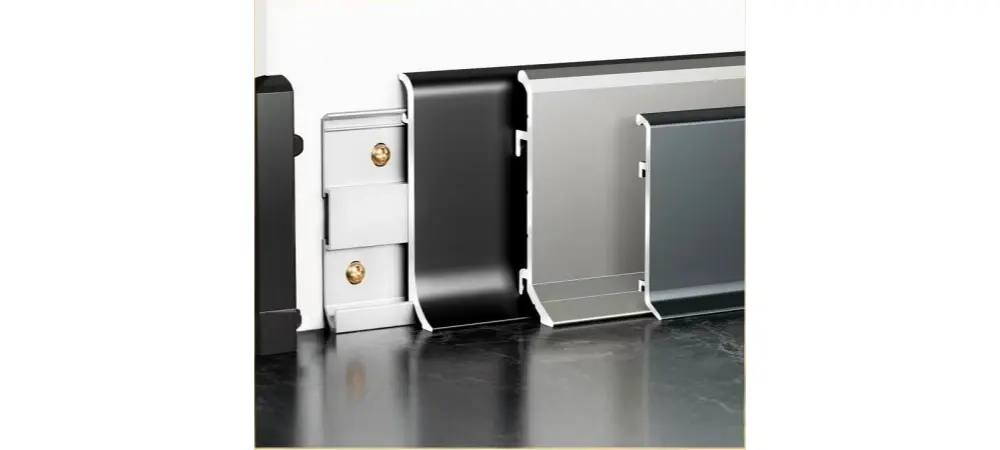
Key Design Features and Types of Snap-Fit Aluminum Skirting
More than just extrusion goes into making skirting systems that work well. Our profiles are processed in several steps, including precision extrusion molding, surface treatment with anodizing or electrophoretic coating, and quality control at six different points before they are packed.
Material Composition and Structural Engineering
We use 6063-T5 alloy because it has the right mix of magnesium and silicon for good extrusion properties while still keeping the structure strong. The term "T5 temper" means that the metal has been heated in a way that improves its mechanical qualities without making it harder to work with. It's easy to see the difference in performance when you compare this to PVC or MDF alternatives:
Aluminum skirting can handle impact forces greater than IK08+ norms. This means that vacuum cleaners, furniture legs, and cleaning tools can hit it over and over again without denting or cracking it. In humid places, wood-based products soak up water and swell within months. Our aluminum profiles, on the other hand, stay the same size even after 96 hours of Neutral Salt Spray testing (GB/T 5237, 2022).
Different projects need different thicknesses, 0.8mm and 1.5mm. The thinner gage is better for residential uses where saving money is important, while the thicker gage is better for commercial uses in hotel hallways or hospital wings where rigidity is needed.
Comparing Installation Methods and Long-Term Costs
For a traditional installation, skilled workers are needed to spread the glue evenly, hold the profiles in place while it cures, and wipe off the extra glue. This takes about 15 to 20 minutes per linear meter. Snap-fit installation takes about 6 to 8 minutes per meter, even for workers who aren't very skilled. When you apply this to a development with 500 units, the saved labor time means the project can be finished weeks faster.
The benefits are even bigger when you look at the maintenance costs over a 15-year working life. Wood edging needs to be repainted or refinished every so often; UV light changes the color of PVC; and to fix standard fixed-metal systems, the wall has to be taken down. Our cover plates are easy to take off and on, so you can get to the infrastructure below right away without needing special tools or damaging the surface. This cuts down on maintenance-related downtime.
The modular design can also handle changes in temperature. The temperature changes in large, open business areas, which makes things grow and contract. Our track-and-cover method lets the panels move longitudinally, which stops the buckling that happens with rigidly glued installs.
How Snap-Fit Aluminum Skirting Works and Installation Guide
The snap-fit mechanism looks like it is very simple, but it is actually very well engineered. The mounting track has a continuous slot with edges that are cut away. The cover plate has protrusions that fit into the slot and lock with a little pressure. When the parts are taken apart, the process is reversed: outer strain frees the interlock without leaving any marks.
Installation Process for Project Teams
Making sure the walls are clean, dry, and mostly flat is the first step in getting the site ready. Minor flaws up to 2 mm are fine because the track is flexible enough to handle small changes. To cut, you need a miter saw with a carbide blade with a high tooth count that is made for non-ferrous metals. This makes sure that the 45-degree joints at the corners are clean.
For walls made of different types of materials, the snap-fit aluminum skirting track is attached with the right fixings: expansion screws for concrete, toggle bolts for hollow blocks, or construction glue for smooth surfaces. Putting fixings every 40 to 50 cm apart gives enough support without being too complicated. Running the track along the walls all the way through makes the mounting base, and inside and outside corner connectors keep the alignment at the corners.
Cover plates are put in last, ideally after the flooring is finished. Starting at one end, panels snap onto tracks. Press along the length of the track to engage the full interlock. End caps hide any rough edges and give the piece a finished look. The whole process creates very little dust or trash, which is very helpful in busy areas that are being renovated.
Maintenance and Lifespan Optimization
Cleaning surfaces regularly with a mild detergent and a soft cloth keeps them looking good without hurting finishes. Anodized coatings should not be cleaned with steel wool or harsh cleaners that are rough. Rinsing every three months helps keep minerals from building up in seaside areas exposed to salt air.
The cover can be taken off, which makes it easier to replace or fix cables. Cutting off a piece only takes seconds and gives you instant access to pipes or wiring that is hidden behind the skirting. In business settings, where technology changes faster than building lifespans, this feature is very useful.
The expected service life is between 20 and 30 years in residential settings and between 15 and 25 years in high-traffic commercial settings. This is a lot longer than the 5 to 10 years that wood or composite alternatives usually last. Aluminum lasts a long time because it doesn't rot, splinter, or allow living things to grow on it. Plus, current surface processes make it resistant to UV damage and chemical exposure.

Procurement Considerations and Decision-Making for Snap-Fit Aluminum Skirting
When sourcing for multi-phase building projects, you have to weigh the up-front costs against the value over the project's entire life. Even though metal edging costs more than MDF at first, it usually ends up being cheaper in the long run because it doesn't need to be adhered, requires less work, and doesn't need to be replaced as often.
Evaluating Supplier Capabilities and Certifications
Quality certifications give procurement teams peace of mind that they are reducing risk. Check to see if providers have ISO 9001:2015 Quality Management Systems in place and that their products have the right certifications. Our manufacturing partner, Zhengzhou Keyi Aluminum, has three integrated sites that cover 132 mu and have all the necessary environmental and safety permits. This size makes sure that they can handle big orders while keeping the quality of each batch the same (ISO, 2015).
With factory-direct buying, there are no markups for distributors, so the prices are 15–25% lower than through retail outlets. This is especially important for orders that are bigger than 5,000 linear meters. Before agreeing to full orders, ask for pre-production samples to make sure the colors are correct, the sizes are correct, and the snap-fit engagement quality is good.
Customization Options and Lead Time Management
Standard production runs of our profiles are delivered in 7–10 days. Custom color matching or heights that aren't standard take an extra 2–3 weeks for tooling adjustments. Using these lead times to plan when to buy things keeps projects from being late. Our dedicated mold inventory of more than 300 sets gives us the freedom to accommodate different heights or custom profiles without having to do a lot of retooling.
In order to handle cash flow, payment terms for snap-fit aluminum skirting are important. Large developers often agree to make payments in stages, with 30% due as a deposit, 40% due when the project is shipped, and 30% due after the installation has been checked. Making these terms clear from the start helps avoid disagreements and makes the project run more smoothly.
Aside from unit price, compare quotes from different suppliers. Think about the quality of the packaging—poor security during shipping leads to damage that slows installation. Check to see if the mounting hardware, corner accessories, and end caps are priced separately or if they are included. When working on big projects, hidden costs add up fast.
Applications and Performance of Snap-Fit Aluminum Skirting in B2B Industries
Real-world performance data from finished projects shows that the method can be used in a variety of climates and types of buildings. A Kuala Lumpur home development with 300 units said that the new wood skirting was installed 40% faster than the old standard wood skirting. This meant that the units were handed over early and the income was recognized faster. The system's antimicrobial aluminum surface, which supports strict hygiene rules, was praised in a hospital corridor renovation in Riyadh.
Commercial Construction and High-Traffic Environments
When it comes to tenant improvements, grade A office places put freedom first. The cover plates on snap-fit skirting can be taken off, which lets facility managers change the layout of the cables for different workstations without having to hire contractors. One company's offices in Dubai said that switching from fixed skirting to our modular system cut the cost of upgrading their IT equipment by 60%.
In retail settings, things like shelves and tools are moved around a lot. Solid metal profiles don't get cracks and chips like wood-based ones do because they are more resistant to impact. A shopping mall owner in Manila said that none of the 50 retail units' skirting had to be replaced during their first three-year lease cycle. This was a big improvement from the old material choices, which needed to be touched up every year.
Residential Developments and Moisture-Critical Zones
Traditional border materials don't work well in bathrooms, laundry rooms, and basements. When moisture gets into MDF, it swells and separates from the backing. Mold can grow on wood. The non-porous surface and corrosion-resistant layer of aluminum keep their shape even in places with 90% or more humidity. A high-end building project in Singapore only wanted to use our system in wet areas because their previous development had a lot of problems with moisture-related calls.
Buyers who are picky care about how the transitions between floors look. Developers avoid the visual break that comes with using different types of flooring by using the same skirting profile with marble tile in the lobbies, engineered hardwood in the living areas, and porcelain in the bathrooms. This level of uniformity raises the perceived quality, which gives them a competitive edge in high-end home areas.
Our ability to make things lets us handle the large amounts of purchases that come with big projects. With three satellite plants that are part of the Keyi Aluminum system, we've been able to meet single-project orders of more than 15,000 linear meters while still meeting deadlines and maintaining quality standards. This production scale is important for projects that involve more than one tower and have different due dates.
Conclusion
Snap-fit aluminum skirting is used for more than just decorating walls; it's a smart purchase choice that affects project timelines, labor costs, and the building's performance over time. The adhesive-free installation cuts the amount of work that needs to be done on-site in half and avoids damage to the walls and mess. The material's longevity means that it will last for 15 to 30 years in a wide range of settings, from humid tropical conditions to busy business areas. With a modular design, future renovations and cable access can be done without tearing down walls.
There are real benefits for real estate developers, general contractors, and building managers. For example, projects are finished faster, there are fewer calls back for water damage, upkeep is easier, and quality is uniform across multi-phase developments. This method is great for big projects where sticking to a schedule, staying within budget, and making sure the quality is always the same because it works well and looks good in a variety of settings.
FAQ
How long does aluminum skirting last in coastal environments?
Coastal sites are more likely to rust because the air is full of salt. Based on rapid weathering tests that are the same as 10 years of seaside exposure (ASTM B117), our anodized aluminum profiles with a covering thickness of 10-15µm can handle these conditions for 20 years or more. Rinsing your teeth every three to four months gets rid of salt buildup and makes your teeth last longer. In the real world, projects in Dubai Marina and along the Mediterranean coast have shown that this works well.
Can I match skirting color to specific flooring or wall finishes?
For orders over 1,000 linear meters, custom color matching is possible. If you give us a sample of the finish you want, our coating experts will come up with powder coat or anodizing processes that will match. Standard colors like silver, champagne, and black go with 80% of home and business design schemes. To give enough time for custom production runs, the finish selection process should happen during the design development stages.
What happens if a section gets damaged during construction?
Each cover plate can be changed on its own, without affecting the mounting track or sections next to it. During building, keep extra parts on hand so that you can fix any damage right away. With glued installs, you have to fix the wall and take out the piece, but with snap-fit systems, you can make isolated changes in minutes. During the fit-out phase, when many trades are working at the same time, this function is very helpful.
Partner with ZX for Reliable Aluminum Skirting Solutions
Teams in charge of buying things for business projects or apartment towers need suppliers who know how to work with tight deadlines and high standards for quality. Zhengzhou Zhongxiu Building Materials has access to production capacity directly from the factory and has the knowledge to help with international projects in Southeast Asia, the Middle East, and other places. Our relationship with Keyi Aluminum as a snap-fit aluminum skirting maker lets us meet the needs of large orders while keeping the tight tolerances needed for a smooth fitting. Together, they run three combined facilities with more than 300 dedicated molds.
Ask for pre-production samples to make sure that our quality standards are in line with what you need for your project. Our team gives you technical advice on choosing the right height, finish, and installation best practices for the type of building you have. You can email us at info@kangdishi.com or go to zhongxiudecor.com to talk about your needs. We offer factory-direct prices, production times of 7–10 days, and uniform quality across multiple batches, which helps you stick to your project plans and budgets.
References
1. Aluminum Association (2021). Standards for Aluminum Extrusion Products: Mechanical Properties and Applications. Washington, DC: Aluminum Association.
2. ASTM International (2019). ASTM B221: Standard Specification for Aluminum and Aluminum-Alloy Extruded Bars, Rods, Wire, Profiles, and Tubes. West Conshohocken, PA: ASTM International.
3. European Commission (2020). Construction Products Regulation (EU) 305/2011: Fire Classification of Construction Materials. Brussels: European Commission.
4. GB/T 5237 (2022). Aluminum Alloy Extruded Profiles for Architecture - Part 1: General Requirements. Beijing: Standards Press of China.
5. ISO (2015). ISO 9001:2015: Quality Management Systems - Requirements. Geneva: International Organization for Standardization.
6. National Association of Home Builders (2023). Life Expectancy of Building Materials and Components Study. Washington, DC: NAHB Research Center.
Online Message